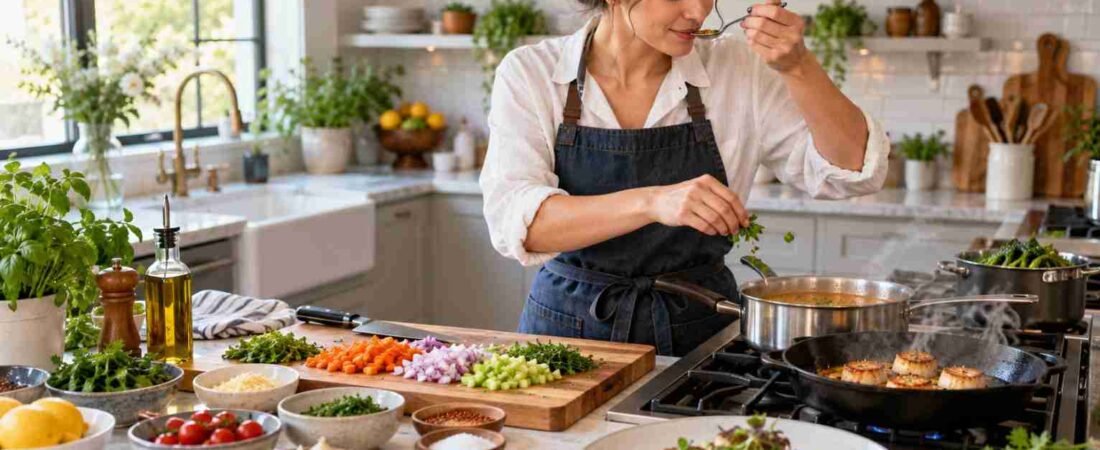
For years, I believed learning how to cook better required memorizing hundred-step French recipes or buying expensive specialty equipment. It does not. Professional kitchen consistency comes down to four fundamental habits: workspace organization, surface moisture control, active flavor balancing, and thermal precision. Once I abandoned recipe dependency and focused on foundational physics and taste chemistry, my everyday meals leveled up immediately.
Master Mise-en-Place and Knife Consistency
Culinary school programs teach mise-en-place—French for “everything in its place”—on day one for a practical reason: heat does not wait for you to chop an onion.
When I set diced vegetables, measured oils, and measured aromatics into individual prep bowls before touching a burner, cooking shifts from a frantic scramble to a relaxed, controlled assembly line. For more practical meal ideas that fit this organized approach, try these Easy Lunch Recipes for Workdays.
Uniform Cuts for Predictable Cook Times
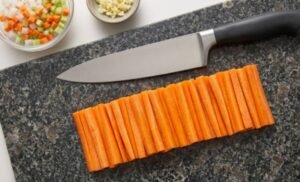
Uneven chopping produces uneven results. If one carrot piece measures an inch thick while another measures a quarter-inch, the small pieces turn to mush before the large ones soften. Practice your essential kitchen knife skills using an 8-inch chef’s knife sharpened to a 15-to-20-degree edge. Consistent knife cuts ensure identical cellular breakdown and uniform heat transfer across the entire pan.
| Cut Style | Target Dimensions | Ideal Applications | Cooking Dynamics |
| Fine Brunoise / Mince | 1/16 in × 1/16 in × 1/16 in | Aromatics (shallots, garlic, ginger) | Releases juices instantly; burns in under 60 seconds of unmonitored direct heat. |
| Small Dice (Macedoine) | 1/4 in × 1/4 in × 1/4 in | Sauté bases, mirepoix, hearty soups | Softens uniformly within 5 to 7 minutes of gentle sweating. |
| Medium Dice (Parmentier) | 1/2 in × 1/2 in × 1/2 in | Root vegetables, stews, hash dishes | Retains structural integrity during long simmer cycles (25+ minutes). |
| Batonnet / Matchstick | 1/4 in × 1/4 in × 2 in | Stir-fries, slaws, raw vegetable garnishes | Maximizes surface area for blistered sear while preserving interior snap. |
Control Thermal Energy and Surface Moisture
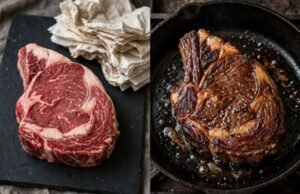
The greatest barrier to deep flavor is excess surface moisture. Water boils and turns to steam at 212°F (100°C), while the Maillard reaction—the chemical cascade responsible for deep savory crusts—demands temperatures between 280°F and 330°F. As demonstrated in extensive testing by culinary labs like Serious Eats, any liquid sitting on the surface of meat or vegetables forces the pan energy into boiling off water rather than browning.
The Mechanics of a True Pan Sear
- Dry the surface thoroughly. Press proteins firmly with clean paper towels until the exterior looks matte.
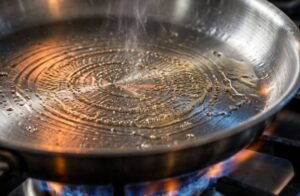
- Preheat the vessel dry. Let a heavy stainless steel or seasoned skillet heat over medium heat before adding oil. Check our cast iron pan seasoning guide to keep your cookware slick.
- Wait for oil shimmer. Cold oil absorbs into porous foods. Pour in high-smoke-point oil (avocado, canola, or grapeseed) and wait until it ripples across the surface.
- Avoid pan crowding. Keep at least one inch of clearance between pieces. Crowded food traps evaporative moisture, causing the ingredients to steam in their own juices.
| Pan Surface Material | Optimal Heat Transfer Rate | Stick Resistance | Best Suited For |
| Enameled Cast Iron | Slow warm-up, extreme heat retention | Moderate | Long braises, deep frying, Dutch oven bread baking |
| Multi-Ply Stainless Steel | Fast, responsive, even distribution | Low (requires heat/fat management) | Pan sauces, fond generation, quick vegetable sautés |
| Carbon Steel | Rapid response, high heat tolerance | High (when well-seasoned) | High-heat stir-fries, pan-searing delicate fish filets |
Train Your Palate Beyond “Seasoning to Taste”
Recipes routinely conclude with the vague instruction to “season to taste.” Professional cooks rely instead on structured sensory evaluation. In my kitchen, I follow a strict Two-Spoon Rule: take a sample from the pot with a clean prep spoon, transfer it to a tasting spoon, and analyze the profile across specific tongue receptors before adding any additional spice.
The Four Pillars of Sensory Balance
When a soup, sauce, or sauté feels incomplete, home cooks often instinctively add more dry spices or salt. Most of the time, the dish lacks acidity or structural fat. Research compiled by sensory nutrition experts at the Harvard T.H. Chan School of Public Health shows that acid actively lowers our perception of bitterness while heightening perceived salinity, reducing the need for heavy sodium additions.
[ FLAT / BORING DISH ]
│
Does it taste dull?
├── YES ──► Add 0.5% Salt by volume
└── NO
│
Does it taste heavy / greasy?
├── YES ──► Add Acid (Lemon / Vinegar)
└── NO
│
Does it taste sharp / hollow?
└── YES ──► Add Fat (Butter / EVOO)
| Flavor Problem | Root Cause | Primary Fix | Secondary Stabilizer |
| Flat / One-Dimensional | Insufficient sodium to bind volatile aromas | Fine sea salt or kosher salt in small increments | Fish sauce, soy sauce, or aged parmesan (umami) |
| Heavy / Cloying | Excess unbroken fat coating the tongue | Lemon juice, sherry vinegar, or pickled brine | Fresh herbal oils or grated citrus zest |
| Sharp / Bitter | Unbuffered tannins or raw acid spikes | Unsalted butter, cold-pressed olive oil, or heavy cream | A pinch of brown sugar or caramelized onions |
| Hollow / Thin Mouthfeel | Lack of gelatin or dissolved emulsions | Reduced homemade bone stock or starch slurry | Cold butter mount (monter au beurre) off direct heat |
Precision Habits: Eliminate Guesswork at the Stove
Tapping a steak with your index finger to gauge doneness is an unreliable myth. Meat density varies by cut, grade, fat distribution, and aging method. Invest in an instant-read digital probe thermometer and manage your proteins by internal core temperature.
To maintain food safety without overcooking your dinner, refer to official targets published by the USDA Food Safety and Inspection Service. Always remove meat 5°F below your ultimate target temperature to account for carryover cooking, then let it rest uncovered on a warm board for 5 to 10 minutes. Resting allows muscle proteins to relax, preventing natural juices from purging onto the cutting board.
| Protein Cut | Pull Temp (Accounting for Carryover) | Final Target Internal Temp | Mandatory Rest Window |
| Chicken Breast | 160°F (71°C) | 165°F (74°C) | 5 minutes |
| Pork Chops (Medium) | 140°F (60°C) | 145°F (63°C) | 5 minutes |
| Ribeye Steak (Medium-Rare) | 130°F (54°C) | 135°F (57°C) | 8 to 10 minutes |
| Salmon Filet | 120°F (49°C) | 125°F (52°C) | 3 minutes |
Ditch the Cookbook Crutch: Cook with Your Senses
Stop viewing recipes as mandatory instruction manuals; treat them as loose roadmaps. One-pan dinner recipes can be especially useful when you want to focus on heat, timing, and ingredient interaction without managing several separate dishes. Your stove burner output, the water content of your produce, and the humidity in your room will never match the recipe developer’s kitchen.
Tonight, step up to the stove and track one single meal using temperature, touch, and flavor checks. Dry your pan proteins completely, taste your sauce base midway through cooking with the two-spoon test, and pull your chicken with an instant-read probe. Once you master the underlying kitchen physics, cooking stops being a chore and becomes second nature.
Frequently Asked Questions
1. What is the fastest habit I can adopt to improve my daily cooking?
Pat your proteins bone-dry with paper towels before searing so you produce a rich, crisp Maillard crust instead of steaming your meat.
2. Why do my sautéed vegetables turn out soggy instead of crisp?
You are overcrowding your skillet, which traps rising steam and boils the vegetables in their own juices.
3. How do I fix a soup that tastes completely flat even after salting?
Whisk in a half-teaspoon of fresh lemon juice or sherry vinegar to brighten the flavors and cut lingering heaviness.
4. How can I tell if my skillet is hot enough for searing?
Add a small droplet of water to the dry pan; if it glides and rolls across the surface like a bead of mercury, your skillet is ready for oil.