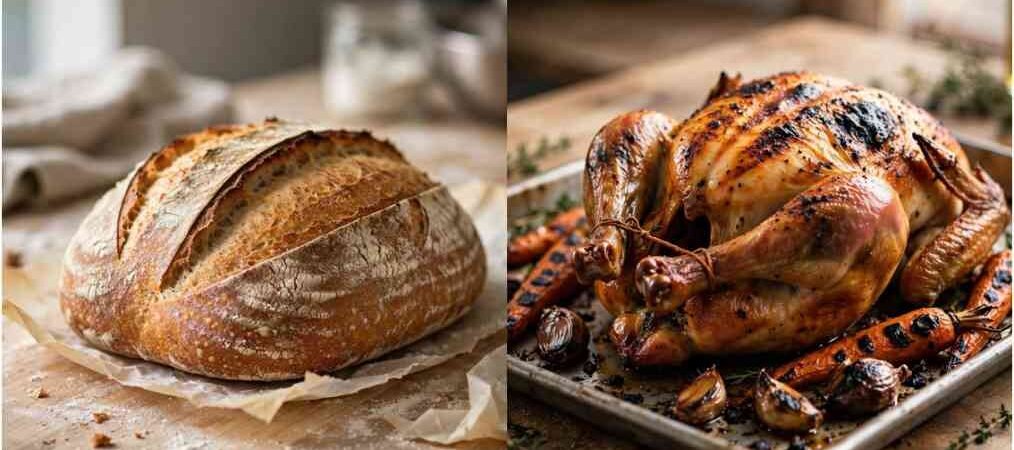
When you slide a sheet pan into your oven, the technique you choose dictates texture, moisture retention, and flavor development. While both methods rely on dry, enclosed heat, baking vs roasting comes down to three clear variables: initial food structure, ambient temperature, and pan airflow dynamics. Confusing the two often leads to soggy root vegetables or burnt, undercooked cakes.
Over years of kitchen testing, I have watched home cooks struggle with pale vegetables and dense breads simply because they treated their oven as a passive hot box. Knowing when to bake and when to roast turns unpredictable oven results into repeatable culinary wins.
Quick Comparison: Baking vs. Roasting
| Feature | Baking | Roasting |
| Typical Temperature | 325°F to 375°F (163°C to 190°C) | 400°F to 450°F (204°C to 232°C) |
| Initial Food Structure | Liquid batters, slack doughs, unsupported mixes | Pre-existing solid structure (whole meats, tubers, root crops) |
| Primary Goal | Starch gelatinization, protein coagulation, rising | Surface dehydration, caramelization, Maillard browning |
| Fat Distribution | Mixed internally into batters or dough matrices | Coated externally on surface skin or flesh |
| Cookware Used | Walled vessels (loaf pans, cake rounds, ramekins) | Low-rimmed sheet pans, roasting pans with wire racks |
| Airflow Exposure | Low to moderate (shielded by pan walls) | High (unobstructed across all exterior surfaces) |
1. Food Structure: Structural Creation vs. Surface Transformation
The simplest baseline test starts before the oven door closes: look at the structural integrity of your raw ingredient.
Baking Builds Structure from Liquid Batters and Doughs
Baking takes an unstructured or semi-liquid mixture and solidifies it into a cohesive crumb. When you slide a cake batter, muffin mix, or enriched brioche dough into the oven, you rely on heat to trigger chemical leavening, starch gelatinization, and protein coagulation.
According to foundational baking science from King Arthur Baking Company, starches begin absorbing water and swelling between 140°F and 150°F, creating structural rigidity before the proteins completely set. Without this precise internal transformation, your baked goods would collapse into dense, unpalatable puddles.
Roasting Intensifies Pre-Existing Solid Foods
Roasting applies dry heat to an ingredient that already possesses a fixed physical shape. A whole chicken, a prime rib, a block of squash, or a handful of Brussels sprouts enters the oven solid and leaves the oven solid.
Your goal here is not structural creation, but surface dehydration, interior tenderization, and flavor concentration. If you want to learn to cook chicken properly, you must balance radiant heat so the interior reaches safe minimums without scorching the skin.
2. Temperature Thresholds and the Maillard Science
The thermal line between these two techniques sits at 375°F to 400°F. Crossing that boundary fundamentally shifts the chemical reactions occurring on the food’s surface.
300°F 350°F 375°F 400°F 450°F
|—————–|—————–|—————–|—————–|
GENTLE BAKING ZONE CROSSOVER INTENSE ROASTING
(Uniform heat penetration, (Browning & (Maillard reaction,
starch setting, no burning) drying begin) surface crisping)
Why Lower Heat Allows Batters to Rise Uniformly
Baking operates at moderate temperatures, generally between 325°F and 375°F. This lower thermal window ensures that ambient heat penetrates to the cold center of the batter at roughly the same rate that the exterior edges set.
If you attempt to bake a standard cake at 425°F, the exterior crust hardens and carbonizes before the center can release trapped gases and finish cooking. The trapped steam then ruptures the set crown, creating a cracked, uneven loaf with a raw, gooey center.
How 400°F+ Heat Triggers the Maillard Reaction
Roasting takes advantage of high heat—typically 400°F to 450°F—to kickstart the Maillard reaction. This chemical cascade between amino acids and reducing sugars accelerates above 300°F and hits maximum efficiency above 350°F, provided all free surface water has evaporated.
Culinary scientists at Serious Eats demonstrate that high heat quickly drives off moisture from the outer cellular layers of meats and vegetables. This rapid surface dehydration allows surface temperatures to climb high enough to yield the crispy, savory, deeply browned crust characteristic of perfectly roasted vegetables.
3. Fat Placement and Pan Wall Dynamics
Oven heat transfers via conduction, radiation, and convection. Your choice of cookware and fat placement dictates which transfer method dominates.
How Sidewall Height Traps Evaporated Steam
During kitchen trials with root vegetables, I measured moisture loss using two different pans in identical 425°F ovens:
- A standard 2-inch-deep casserole dish
- A rimless heavy-gauge baking sheet
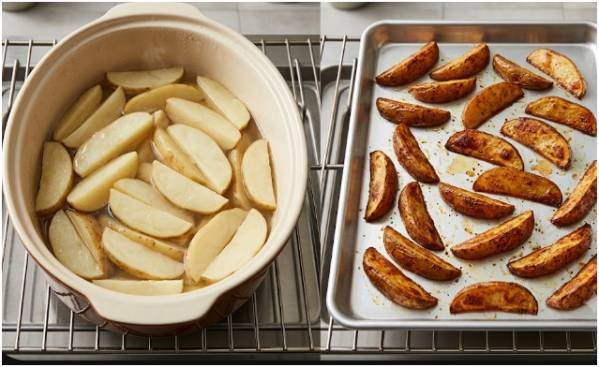
The vegetables in the deep casserole lost 18% less water weight and failed to develop any crisping. The high walls trapped evaporating moisture, creating a micro-pocket of 212°F steam around the vegetables.
DEEP CASSEROLE DISH (Steams Food) FLAT SHEET PAN (Roasts Food)
| ~~~ Trapped Steam ~~~ | Dry Air Circulation —>
| [ Veg ] [ Veg ] | [ Veg ] [ Veg ]
+————————-+ ================================
Roasting requires low-rimmed or rimless sheet pans that allow dry air to sweep directly across the surface of the food. Conversely, baking frequently leverages high-walled pans to support wet batters and protect tender crumb structures from harsh, desiccating air currents.
The Role of Surface Fat in Heat Conduction
In baking, fat (butter, shortening, or oil) is whipped, creamed, or folded directly into the flour matrix to shorten gluten strands and tenderize the crumb.
In roasting, fat is applied externally. Brushing neutral oil over root vegetables or rubbing softened butter under turkey skin creates a continuous conductive layer. This external oil transfers heat from the dry oven air directly to the food’s skin far faster than air alone could manage.
The Crossover Dilemma: Potatoes, Casseroles, and Large Meats
Culinary language does not always follow clean scientific boundaries, leading to occasional naming contradictions.
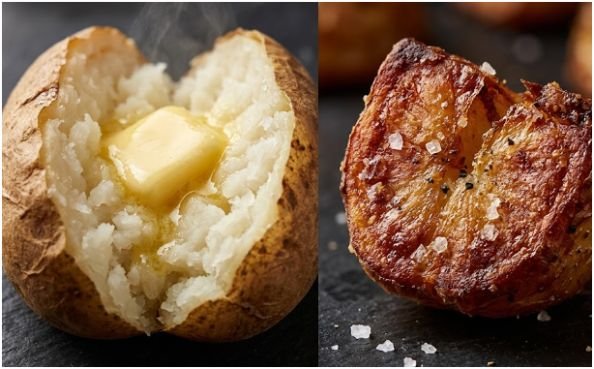
- Potatoes: A standard baked potato cooks whole in its jacket without added surface fat; the skin holds in moisture while the starchy interior steams to a fluffy finish. Roast potatoes, however, are parboiled, tossed aggressively in duck fat or olive oil, and blasted at 425°F on an open sheet pan to achieve a thick, crunchy exterior crust.
- Casseroles: Dishes like lasagna or baked ziti are built with solid, pre-cooked pasta and meats, yet we refer to them as baked. Because they cook at moderate heat (350°F) inside deep, walled vessels—often shielded under aluminum foil—the cooking mechanics match the gentle, enclosed thermal profile of baking.
- Tough Meats and Reverse Searing: A bone-in pork shoulder or beef brisket is technically a roast, yet cooking it at 425°F leaves you with dry, leathery meat. Large cuts require a low-and-slow approach (225°F to 275°F) to allow connective collagen to slowly melt into gelatin.
Many cooks now pair this low-temperature oven stage with a high-heat cast-iron blast; our guide on how to sear steak breaks down how that surface contact achieves maximum crust. For food safety rules regarding core doneness during both fast and slow cooks, always reference the official guidelines from the USDA Food Safety and Inspection Service.
What Your Oven’s “Bake” and “Roast” Buttons Actually Do
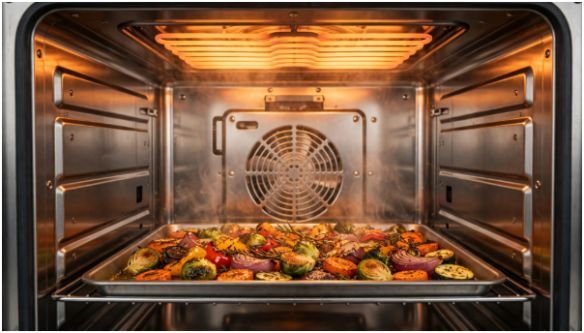
Modern electronic ranges feature dedicated buttons for both methods. These buttons alter which physical heating elements cycle during cooking.
BAKE CYCLE ROAST CYCLE
Top Element: OFF Top Element: Pulsing (20-30%)
[ ] [ v v v ]
[ ^ ^ ^ ] [ ^ ^ ^ ]
Bottom Element: 100% Bottom Element: 70-80%
(Gentle, upward radiant heat) (Intense dual radiant + fan)
The Bake setting powers the bottom heating element almost exclusively. Heat rises gently through natural convection, shielding delicate cakes and rising breads from direct, harsh downward radiation that would scorch their crowns before the batter sets.
The Roast setting runs both the bottom and top broiling elements simultaneously, often cycling the top element at 20% to 30% power while engaging an internal convection fan. This blasts the top surfaces of meats and vegetables with direct infrared radiation and circulating dry air, speeding up browning and crisping fat caps without requiring you to turn on the dedicated broiler.
Frequently Asked Questions About Baking and Roasting
1. Can you roast vegetables in a 9×13 glass baking dish?
No, high-walled glass dishes trap escaping steam, turning vegetables soft and soggy instead of crisp.
2. What exact temperature separates baking from roasting?
The dividing line is 375°F to 400°F (190°C to 204°C), above which surface drying and Maillard reactions rapidly accelerate.
3. Do you cover food when roasting?
Never cover roasting food, as trapping moisture creates steam that halts surface caramelization and prevents crisping.
4. Should I use the convection fan for baking or roasting?
Use convection for roasting to accelerate surface drying and browning; turn it off for delicate baked goods to avoid lopsided rising.
Stop Second-Guessing Your Oven Dials
Choosing between these techniques comes down to matching your thermal strategy to your food’s physical needs. If you need a batter to rise, set, and retain moisture, keep the temperature at 350°F in a walled pan. If you want to caramelize surfaces, render fat, and crisp exterior skins, crank the dial to 425°F, use a flat sheet pan, and let dry heat do the heavy lifting.