
Cut into a hot steak straight off the cast iron, and your cutting board floods with flavorful red juices within five seconds. You worked hard on that crust, only to leave the center dry and stringy. Knowing how long to rest steak separates an average home cook from a skilled grill master.
As a culinary standard, rest average steaks between 5 and 10 minutes, or roughly half the total cooking time. Yet arbitrary timers do not account for thermal mass, surface area, or your cooking vessel. True kitchen control requires calculating the internal pressure of the meat, accounting for carryover cooking, and protecting your hard-earned sear.
STEAK RESTING TIMELINE
PULL FROM HEAT PEAK CARRYOVER REDISTRIBUTED & READY
Internal temp climbs Fibers begin relaxing Juices thicken & set
│ │ │
──────┼───────────────────────────────┼────────────────────────────────┼──────►
0 min 4 min 8-10 min
Juice loss if sliced: Juice loss if sliced: Juice loss if sliced:
HIGH (~28g) MODERATE (~14g) MINIMAL (~4g)
The Science of Muscle Fibers and Carryover Cooking
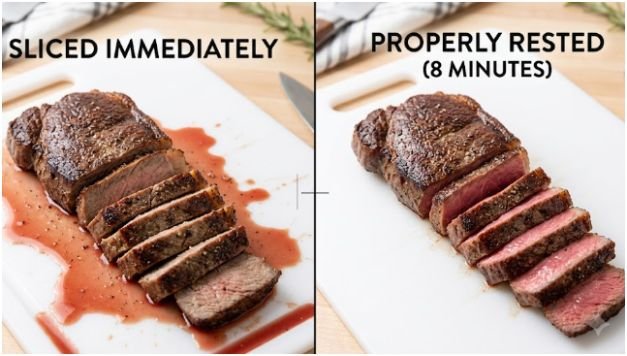
Steak consists largely of water, protein, and fat. When beef hits high heat, muscle fibers contract violently. Just as you must monitor internal heat when learning to cook chicken properly, red meat demands close attention to internal physical dynamics.
Why Trapped Heat Pushes Moisture Inward
As muscle proteins heat past 120°F, they shrink lengthwise and crosswise. This constriction squeezes intracellular moisture away from the blistered exterior and drives it directly toward the cooler center. Slicing immediately releases this pressurized water onto the board.
Resting removes the exterior energy source. As the temperature gradient levels across the meat, tightened muscle bundles relax. The liquid cools slightly, thickens in viscosity, and locks into the cellular matrix. The USDA Food Safety and Inspection Service recommends a three-minute rest on whole cuts for food safety and temperature stabilization, but quality beef benefits from a slightly longer window for optimal texture.
Carryover Temperature Shifts by Pan Type
A steak does not stop cooking when it leaves the fire. Residual surface heat transfers inward, driving up the core temperature. A thin skirt steak cooked over open charcoal might rise only 2°F during resting. Conversely, a thick bone-in ribeye pulled from a blazing 500°F cast iron skillet can surge 5°F to 8°F off the heat. Pull your meat 5°F below your ultimate target to avoid overcooking during the rest.
Calculating Resting Time by Thickness and Cut
Rigid rules fail because a flat flank steak behaves differently than a dry-aged tomahawk.
| Cut Profile | Examples | Average Thickness | Recommended Rest Time | Optimal Resting Surface |
| Thin Cuts | Flank, Skirt, Hanger | Under 1 inch | 3 to 5 minutes | Warm wooden cutting board |
| Standard Steaks | NY Strip, Ribeye, Filet | 1.25 to 1.5 inches | 6 to 8 minutes | Elevated wire rack |
| Thick Bone-In | Porterhouse, Cowboy Ribeye | 1.75 to 2.25 inches | 10 to 12 minutes | Elevated wire rack |
| Large Roasts | Prime Rib, Chateaubriand | 3+ inches | 15 to 25 minutes | Carving board with deep wells |
The 5-Minute-Per-Inch Formula
For standard bone-out cuts, measure resting by depth rather than weight. Allocate five minutes of rest for every inch of thickness. A standard supermarket strip steak measures roughly one inch and needs five minutes. A thick-cut artisan filet measuring two inches requires a full ten minutes to stabilize.
Thin Cuts vs. Thick Roasts
Thin cuts lose ambient warmth quickly. Slicing a skirt steak after eight minutes leaves you with cold fajita meat. Rest thin cuts for just four minutes under ambient room temperature. Huge cuts like a standing rib roast store enormous thermal momentum, requiring up to twenty minutes before the core stops rising and the juices settle.
Tested Results: My 10-Ounce Strip Steak Experiment
To evaluate actual moisture loss, I seared four identical 10-ounce New York strip steaks to an exact internal pull temperature of 128°F using refined tallow. I carved each steak at different intervals, weighed the expelled board juices on an analytical kitchen scale, and assessed crust texture.
- Steak A (Sliced immediately): Lost 28 grams of juice within two minutes. The outer bands were chew-heavy, while the center appeared watery rather than rich.
- Steak B (Rested 5 minutes): Lost 14 grams of juice. The bite showed clear improvement, but a small pool gathered on the cutting surface.
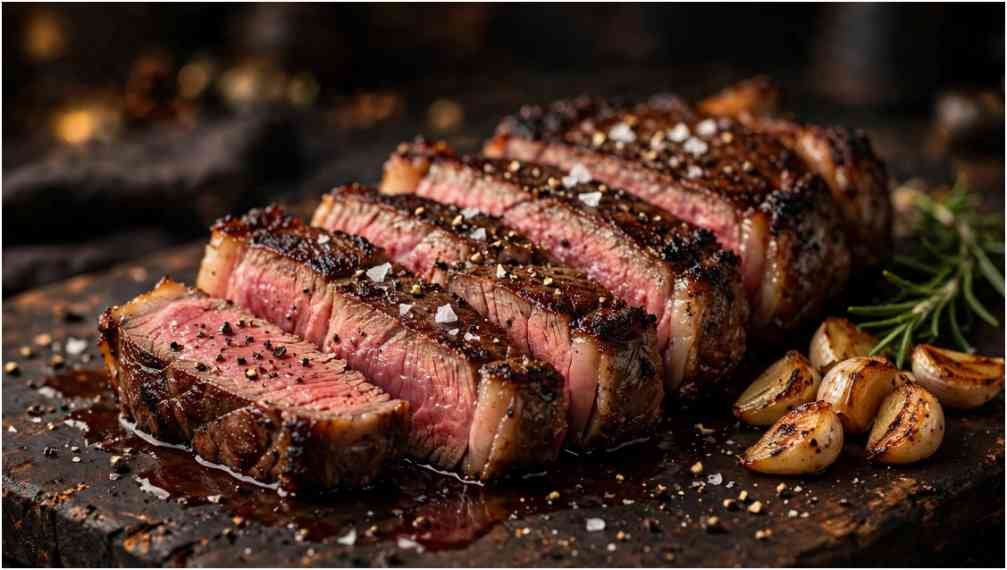
- Steak C (Rested 8 minutes): Lost just 4 grams of juice. The meat remained pink from edge to edge, and the interior retained a buttery, rich mouthfeel.
- Steak D (Rested 15 minutes): Lost 3 grams of juice, showing minimal gain over the 8-minute mark. However, the surface dropped down to 108°F, cooling the fat excessively.
The data gathered in our test kitchen matches empirical findings from culinary researchers at Serious Eats: a rest of eight minutes preserves roughly 85% more moisture than carving immediately, while resting past ten minutes delivers diminishing returns and cool beef.
Common Resting Mistakes That Ruin Your Crust
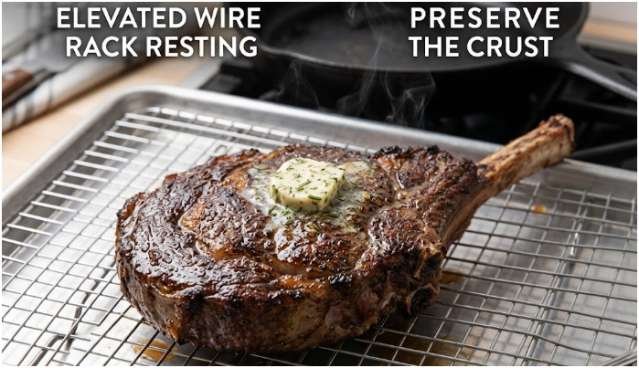
Proper timing means little if your technique compromises your exterior crust.
The Aluminum Foil Steam Chamber
Wrapping meat tightly in aluminum foil ruins a crisp sear. As trapped moisture evaporates off the hot steak, the foil forces that steam back onto the exterior surface, softening the char. Food science writer Meathead Goldwyn at AmazingRibs warns that foil tents act as mini-steamers. If you must shield the meat in a cold room, drape a loose piece of foil over the top like a tent, leaving both sides open for vapor to escape.
Flat Cutting Boards vs. Wire Cooling Racks
Placing hot meat flat on a smooth cutting board traps condensation underneath. The underside of your steak turns mushy. Set a stainless steel wire cooling rack inside a rimmed baking sheet. Resting the steak elevated maintains airflow around the entire perimeter, preserving the crackling exterior created when you learn how to sear steak over extreme heat.
POOR RESTING SETUP OPTIMAL RESTING SETUP
(Traps steam, ruins crust) (Preserves crust, collects juices)
Tight Foil Tent Open Air / Loose Umbrella
┌────────────────┐ ╭───────────────────────╮
│ HOT STEAK │ │ HOT STEAK │
───┴────────────────┴─── ───┴───────────────────────┴───
Flat Cutting Board Stainless Steel Wire Rack
(Bottom turns soggy) Rimmed Sheet Pan (Juice Catch)
Converting Board Drippings into a Fast Pan Sauce
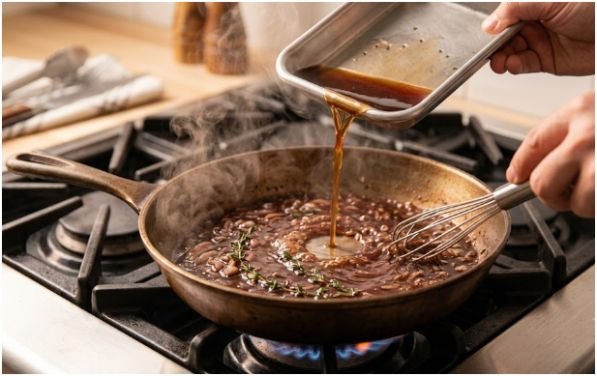
Even with careful resting, your tray collects a small amount of rendered fat and myoglobin. That liquid is concentrated culinary gold. Do not discard it.
While the steak sits on the wire rack, drain excess fat from your cooking skillet, leaving about one tablespoon along with the browned pan fond. Turn the burner to medium heat and sweat one minced shallot for sixty seconds.
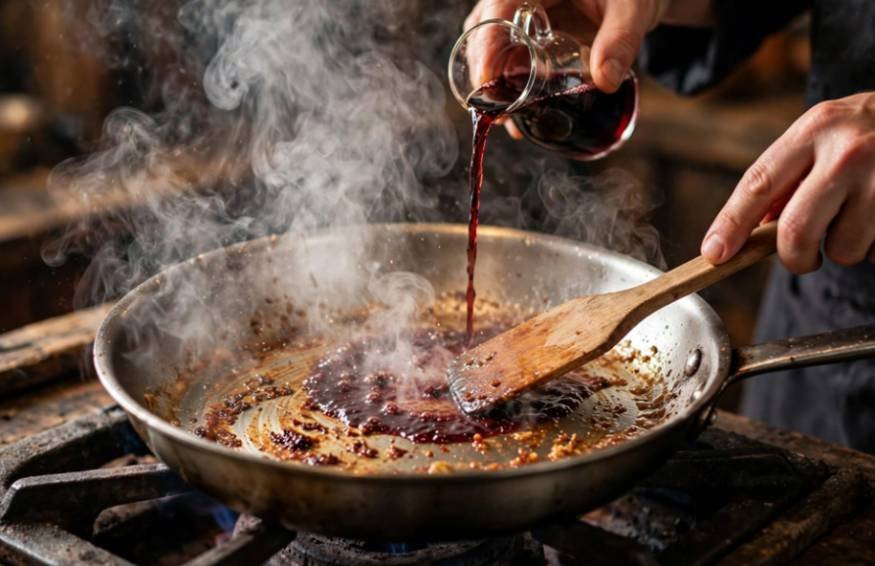
Deglaze the hot surface with a third of a cup of dry red wine or beef stock, scraping up the stuck crust fragments with a wooden spatula.
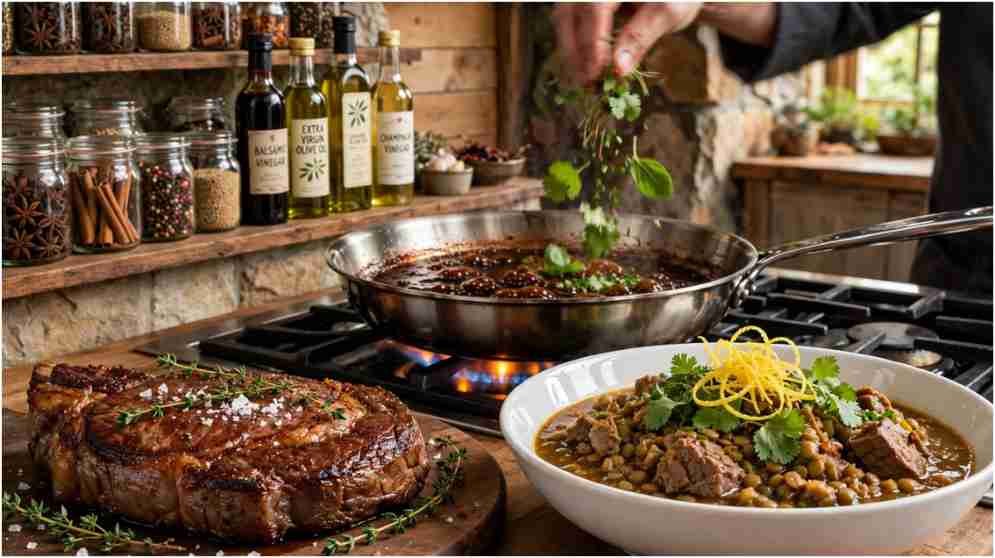
Reduce the liquid volume by half. Cut the heat completely, whisk in two tablespoons of chilled, cubed unsalted butter to create a silky emulsion, and tip the collected resting juices straight from your sheet pan into the skillet. Spoon this glossy reduction over the carved slices for instant restaurant-grade richness.
Put Down the Carving Knife
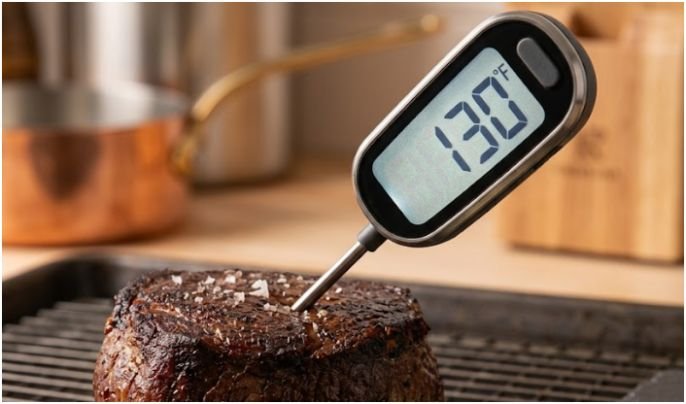
Great steak cookery requires patience after you turn off the heat. Pull your meat five degrees early, set it on an elevated wire rack in a warm kitchen spot, and leave it alone for six to eight minutes. That brief pause allows proteins to relax, keeps juices inside the muscle fibers, and ensures every bite delivers the tenderness you paid for.
Frequently Asked Questions
1. Does resting a steak make it cold?
No, the steak’s internal temperature actually climbs several degrees during the first few minutes off the heat due to carryover cooking.
2. Should I rest steak on a cutting board or a plate?
Rest on an elevated wire rack over a baking sheet to keep condensation from softening the bottom crust.
3. Do reverse-seared steaks need to rest?
Because reverse-seared steaks cook slowly before a quick final flash-sear, they require only two to three minutes of resting.
4. Can you rest steak too long?
Yes, resting past twelve minutes cools the surface excessively, causing intramuscular fats to solidify and reducing overall juiciness.